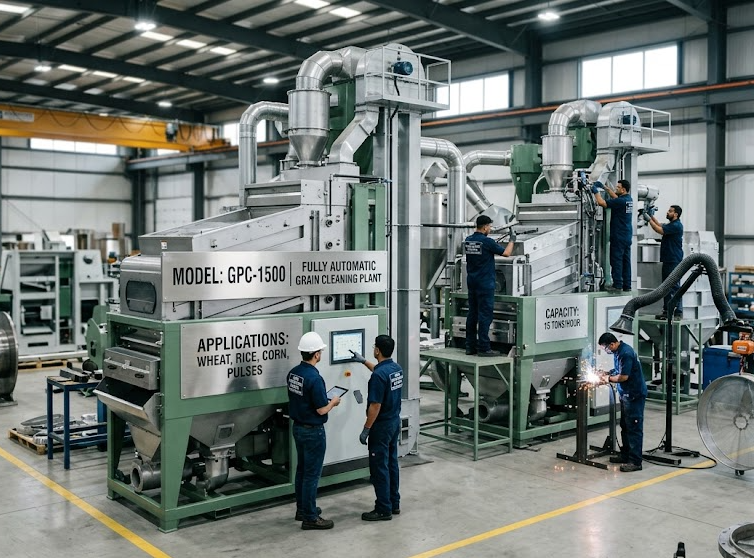
Hygiene is not a matter of choice nowadays in the food processing industry, but rather a critical quality factor that has to be met. This is particularly the case in the production of besan, where the risks of contamination can have a direct effect on product safety, shelf life, and brand reputation. A completely automatic grain cleaning plant provides a contemporary and clean solution that significantly reduces human contact and guarantees controlled and enclosed processing throughout the entire operation.
The top manufacturers of fully automatic grain cleaning plants manufactures these systems to adhere to very strict food safety standards while at the same time ensuring quality and efficiency consistency. With the use of automation, grain cleaning producers will be able to deliver the highest hygiene standards, meet regulatory requirements, and gradually build up consumer trust in their products.
Understanding What a Fully Automatic Grain Cleaning Plant Is
An automatic grain cleaning plant is a high-tech food processing plant that, with the least manual assistance, gives high-quality grain cleaning from chickpeas. Renowned automatic grain cleaning plant manufacturers have merged automation, precision control, and hygienic engineering to guarantee a constant output and food safety.
Main characteristics are:
- Cleaning, grinding, sieving, and packing are fully automated.
- Material handling systems that are enclosed
- Quality of production that is constant
- Less reliance on manual labor
The Hygiene Challenges in Traditional Grain Cleaning Production
The methods of manufacturing grain cleaning through traditional means are fraught with several hygiene risks at every stage of production. The reasons for these risks are open processing and high human involvement. Consequently, the resulting product may suffer from contamination and variances in quality.
The main hygiene problems are:
- Direct human contact with the raw ingredients
- Grinding and sieving are done in the open
- Dust, insects, and moisture are everywhere
- Keeping sanitation standards is a hard task
How Fully Automatic Grain Cleaning Plants Ensure Superior Hygiene
Every step in a fully automatic grain cleaning plant is designed to ensure cleanliness. With less handling and consistent workflows, they bring about a cleaner and safer production environment.
Some of the hygiene advantages are:
- Processing lines that are completely enclosed
- The totally automated flow of materials
- Operating conditions that are monitored
- Possible cross-contamination is minimized
Role of Fully Automatic Grain Cleaning Plant Manufacturers in Food Safety
Completely automated grain cleaning plant producers are very important in the food safety chain as they are the ones who make and provide systems conforming to the rigorous hygiene and health regulations. Their know-how is not limited to machine-making; they rather focus on building up entire processing solutions that will be least likely to pollute and cause the product to lose its quality. By applying the principles of hygienic engineering, using the latest technology, and employing food-grade materials, the manufacturers make the operations of the grain cleaning producers safer and more reliable.
The contributions made are:
- Designing closed, contamination-free processing lines
- Using food-grade stainless steel and approved components
- Integrating automation to reduce human contact
- Ensuring compliance with FSSAI, ISO, and GMP standards
- Advising on hygiene maintenance and audits
Enclosed Cleaning and Washing Systems for Raw Chickpeas
Enclosed systems for cleaning and washing are indispensable for hygiene control during the very first stage of grain cleaning production. Fully automatic setups clean the raw chickpeas, taking care of the human health aspect, and thus laying a very safe processing base. Manufacturers of top-class fully automatic grain cleaning plants incorporate these setups in their design to make the plant soil-free with very little human intervention.
The major benefits come as follows:
- Automated elimination of impurities, stones, and dust
- Underground washing for external contamination prevention
- Human contact with raw materials decreased
- Raw material hygiene and quality increased
Dust-Free Grinding and Milling for Contamination Control
Dust control is one of the primary hygiene problems in grain cleaning production. Sealed grinding systems are being used by fully automatic plants to eliminate the possibility of contamination through air.
The dust-free characteristics are as follows:
- Grinding chambers that are completely enclosed
- State-of-the-art aspiration systems
- Cleaner environment in the workplace
- Higher product purity
Automated Sieving and Grading for Uniform Quality
Using automation, the same texture of grain cleaning is maintained, and there is no need for human contact. The leading manufacturers of completely automatic grain cleaning plants have installed precision sieving technology for grading in a hygienic way.
Main advantages:
- No human contact in the sieving process
- Equal size of particles
- No more sorting by hand
- Germs have less chance of spreading
Food-Grade Material Handling and Construction
Hygiene in grain cleaning production can only be maintained through food-grade material handling and construction. Fully automatic plants are involved in the use of non-reactive materials that have been approved to ensure both product safety and durability. The best manufacturers of fully automatic grain cleaning plants are those that create equipment that not only avoids contamination but also supports long-term, hygienic carbon operations.
Some of the key benefits are:
- Contact parts made of chromium steel (SS 304/SS 316)
- Surfaces that are smooth and resistant to rust
- Cleaning and sanitation are easy.
- Meeting food safety standards
Automation Reducing Human Contact and Error
A major factor in enhancing cleanliness by cutting down human interaction with the production of grain cleaning has been played by automation. The totally automated systems take care of every operation in a controlled and standardized way without manual input. The manufacturers of the best automatic grain cleaning plants have taken the lead in the adoption of automation as a means of lowering the potential for contamination and increasing the precision of the process.
The primary advantages are:
- No or very little human contact with the product
- A lower likelihood of mistakes caused by handling
- Uniform and reproducible processing
- Better hygiene and quality control
Easy Cleaning, CIP Systems, and Maintenance Benefits
The hygiene benefits of fully automatic grain cleaning plants are remarkable and one of the reasons to adopt such systems. Modern installations are made in such a way that regular sanitation can be done with little effort and no or very little downtime. Manufacturers of reputed fully automatic grain cleaning plants include features that make cleaning easier while keeping food safety standards high.
The Benefits are as follows:
- Smattering hygiene through the rapid CIP system
- For Easy cleanliness, small, open surfaces
- Reduced maintenance time and downtime
- Maintaining proper hygiene during the whole process
Meeting the Requirements of Food Safety Regulations and Verification
It is crucial to follow hygiene practices and regulations for the production of besan. Fully automatic systems are made to comply with the stringent regulatory requirements through uniform and regulated processing. The top manufacturers of fully automatic grain cleaning plants make sure that their plants facilitate auditing and certification processes without any hiccups.
The main advantages of compliance are:
- Conformity with FSSAI, ISO, and GMP norms
- Sanitary equipment and plant layout
- Uninterrupted process documentation
- Readiness for inspections has improved.
Long-Term Hygiene, Brand Trust, and Market Advantage
A fully automatic grain cleaning plant manufacturer that keeps up the highest hygiene standards is a good way to gain long-term brand trust and market credibility. Consumers are more confident with quality and production process safety that have been enhanced through manufacturers of fully automatic grain cleaning plants trusted by the market. They are providing solutions that give businesses a competitive edge while ensuring permanent product safety.
Main benefits are:
- Longer product shelf life, Fewer contamination complaints
- Better brand reputation
Conclusion
Investing in an entirely automatic grain cleaning plant represents a smart choice for better hygiene, quality consistency, and compliance with the rules. These systems are designed for safer grain cleaning production with almost no human contact, enclosed processing, and food-grade construction. The fully automatic grain cleaning plants manufacturers that are trusted provide hygienic and future-ready solutions that not only help the producers build brand trust and improve shelf life, but also give them a strong competitive edge in the food processing market that is continuously changing.
FAQs
1. What are the reasons that hygiene is better in a fully automatic grain cleaning plant?
Fully automatic grain cleaning plants consist of human contact minimized to near zero, enclosed systems are used, and all the processes are standardized, which significantly lowers contamination risk when compared to traditional setups.
2. How do manufacturers of fully automatic grain cleaning plants ensure that food safety regulations are met?
Top manufacturers of fully automatic grain cleaning plants fabricate their equipment from food-grade materials and hygienic layouts, and they use systems that meet the standards of FSSAI, ISO, and GMP.
3. Is automation a good fit for small and medium Grain cleaning producers?
Yes, a lot of fully automatic grain cleaning plant manufacturers have solutions that can be modified to fit small, medium, and large production capacities while keeping hygiene standards.
4. Will the cleaning of fully automatic grain cleaning plants take more time?
No, the cleaning process is done easily because of the smooth surfaces, modular components, and optional CIP systems, which all contribute to the reduction of time and effort spent on cleaning.
5. What is the role of hygiene in assessing the quality and shelf life of besan?
High hygiene controls decrease the risk of infection, secure the quality, lower moisture and bacterial growth, and finally, prolong the life of the grain cleaning products.